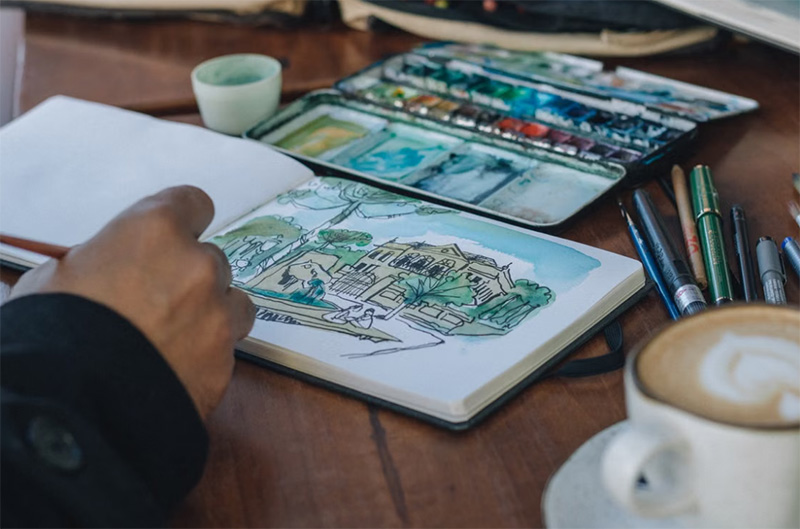
Observation sounds simple until a pencil touches paper. Then the fraud appears. Most people don’t see nearly as much as they think they do. They carry symbols in the head. An eye becomes an almond shape. A tree becomes a lollipop on a stick. A face becomes a cartoon assembled from memory. The sketchbook exposes that laziness fast, and that’s why it matters. A real drawing habit trains attention, not just hand control. What this signals is a shift from naming things to noticing them. Form, spacing, proportion, and mood begin to register with more force.
Draw What’s Boring
The strongest habit starts with an unfashionable choice. Draw ordinary objects. Draw the sink. Draw a shoe that has collapsed into its tired shape. Draw the corner of a receipt hanging out of a pocket. Glamour distracts. Boredom clarifies. When the subject lacks drama, the eye can’t hide behind excitement, and the hand can’t fake intelligence with flashy marks. A cracked mug on a table forces attention onto angles, thickness, tilt, and shadow edges. Memory always simplifies. Reality doesn’t. That’s why humble subjects teach so much.
Measure Before Meaning
Most weak sketches suffer from premature interpretation. The artist decides what something is before checking how it sits in space. Catastrophe follows. A nose gets drawn as a nose instead of a wedge with a certain angle. A chair turns into the idea of a chair rather than a stack of slants and intervals. Better habits begin with comparison. How tall is one shape against another. Where does one line stop beside the next line. This sounds mechanical. Good. Mechanics rescue vision from vanity. Once proportion locks in, character starts to emerge.
Repeat the Same View
Novelty has become a modern addiction, and it ruins practice. One page of a lamp, one page of a hand, one page of a stranger, then off to the next shiny thing. That pattern feels productive and usually produces very little. Repetition cuts deeper. Draw the same window for five days. Draw the same teapot from slightly different distances. Draw the same street corner in morning light, then at dusk. The first drawing catches the obvious. The second catches structural errors. By the third, subtle shifts in value and edge begin to matter. Observation grows through stubborn return.
Write Notes Beside Lines
A sketchbook should not behave like a shrine. It should behave like a lab notebook. Words belong next to drawings. Brief ones. Sharp ones. Note that the shadow under the chin looked cooler than expected. Note that the left side of the vase leaned outward more than memory guessed. Note that the figure’s weight sat on one leg, which changed the whole pose. These comments build a bridge between seeing and thinking. Without that bridge, many people repeat errors with astonishing loyalty. A few honest words on the page can stiffen observation into discipline.
Sharp observation doesn’t arrive as a gift. It grows through habits that look plain from the outside. Draw common things. Check size and angle before chasing personality. Return to the same subject until the obvious details stop hogging the stage. Write down what the eye actually caught instead of trusting a vague impression. None of this sounds romantic, which is exactly the point. Real progress in drawing rarely announces itself with thunder. It creeps in through repeated acts of correction. Then one day the page looks more alive because attention stopped drifting. That’s where honest seeing begins.
Photo Attribution:
1st & featured image by https://www.pexels.com/photo/artist-sketching-in-notebook-with-watercolors-37712111/
2nd image by https://www.pexels.com/photo/three-clothespins-on-clothesline-1366242/

