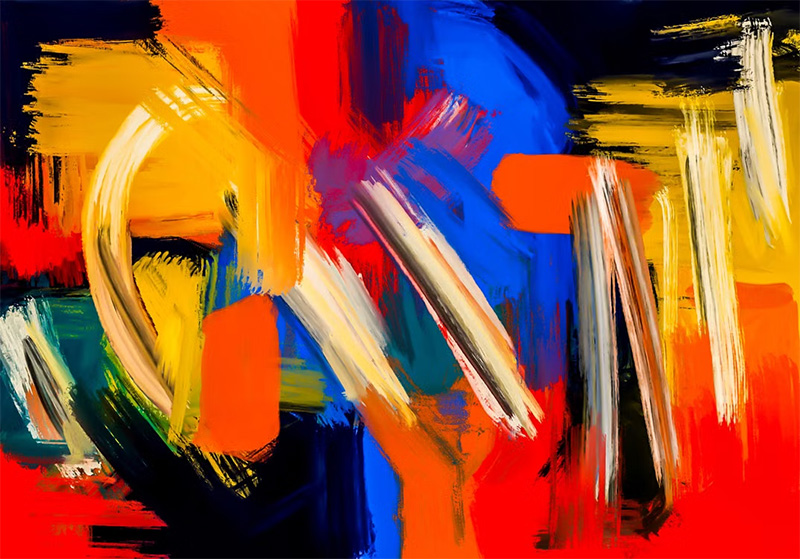
Picture a paintbrush loaded with color, soaring, swooping, dragging oil across raw cotton duck. This approach doesn’t simply depict. It proclaims movement, slaps the audience awake, roots painting in the body. The intellect of the hand, invisible but undeniable, guides every arc and splatter. Who, honestly, can gaze at a Franz Kline or a Joan Mitchell and not feel a pulse moving up through the soles? It’s the refusal to be still that sets this apart. The modern obsession with precision looks cheap by comparison. Here is a kind of wildness, practiced but never only technique.
Sweat, Instinct, Action
Gesture, what a strange concept in a world obsessed with digital stillness. In gestural painting, the arm, the wrist, the very core of a backbone all matter as much as the chosen tool. There’s no place for timid dabbing or careful plotting. Each mark marches across the surface like a boot at a parade: loud, unmistakable in intent. Think about Pollock circling his stretched canvas, not touching as much as attacking the surface. The prim brushstroke is absent. Instead, muscle memory speaks first. Thought follows muscle. The “finished product” becomes a freeze frame of energy, not a quiet tableau.
The Myth of Control
People love to glorify careful planning in painting, as if discipline unlocked some mystical power. This approach flips that. Here, chaos matters. Brushes get flung, wrists jolt, bodies lunge at the canvas. Mistakes? They practically become the point. A flash of color drips south, and suddenly the entire piece must adjust to this intrusion. That’s real control: letting the work steer itself, refusing to straitjacket it with intent. The myth that great art comes from control is exposed as lazy thinking. Better to embrace accident. Great things tend to stumble up from mess, not calculation.
Tools of Expression, Not Constraints
A flat bristle brush could become a sword. Fingers, sticks, spatulas, almost anything will do. The traditional toolbox expands fast. It stops being about accuracy. The bristles break, the paint pools, but who cares? Each tool is a co-conspirator, amplifying quirks and flaws. Practicality bows to personality. A painting knife leaves ragged lines, hinting at violence. Fingertips drag pigment that clings unpredictably to the canvas. Now the tool disappears and only motion remains. In this process, even the surface itself participates. Unprimed linen drinks pigment greedily, soaks up the drama, records everything like an unimpressed historian.
Energy Made Visible
Why bother with all this drama? The answer: energy. Not the fake, caffeinated kind, but real physicality. Gestural painters want to trap the living moment, give it visual substance. Spectators don’t just see a finished painting. They sense movement held in amber. Every line and mark offers a timestamp of the artist’s motion. Pause too long, and the work stiffens, loses pulse. The most successful pieces hum with stored activity, as if the action is still unfolding. This is a canvas as battleground, not a quiet park. It compels engagement far more than polite passivity.
Gestural painting stands as a stubborn refusal to quiet the body in art. What matters isn’t the prettiness or harmony of the finished piece, but the lived action preserved within it. Viewers react to the charge left by someone else’s arm and nerve. The modern gallery risks becoming a mausoleum without this kind of disruption. Artists that press the outer limits of movement reinvigorate what painting can mean. They stop the eye from idling. Here, painting finds its heartbeat again, drumming out proof that chaos, risk, and sweat still belong on the wall, resisting the neatness of all that’s safe and predictable.
Photo Attribution:
1st & featured image by https://www.pexels.com/photo/colorful-stains-of-paint-14995425/
2nd image by https://www.pexels.com/photo/man-pouring-water-on-himself-10226373/

