Japanese woodblock prints did not enter history as mere decoration. They emerged from the cities of Edo-period Japan, where merchants gained wealth, theater crowds wanted sensation, and images moved through society far faster than elite painting ever could. A print could carry glamour, gossip, fashion, travel, desire, and blunt commercial ambition at once. Fine art often claims distance from ordinary life. Ukiyo-e shattered that claim. These prints belonged to urban appetite. They sold beauty, celebrity, weather, erotics, and fantasy, then preserved an entire social pulse for later centuries with startling clarity.
City Heat
The roots of ukiyo-e sit in Edo, later Tokyo, during a long period of peace that fed population growth, consumption, and spectacle. Peace changes art. War commissions armor and horses. Peace buys actors’ portraits and scenes of pleasure districts. The word ukiyo pointed to the floating world of fleeting pleasure. That shift says much about the age. Merchants, artisans, and townspeople wanted images of the life they actually chased after dark. Kabuki stars, courtesans, wrestlers, and famous places all entered the market. This was commercial art, yes. It was also social evidence with real bite.
Carved Collaboration
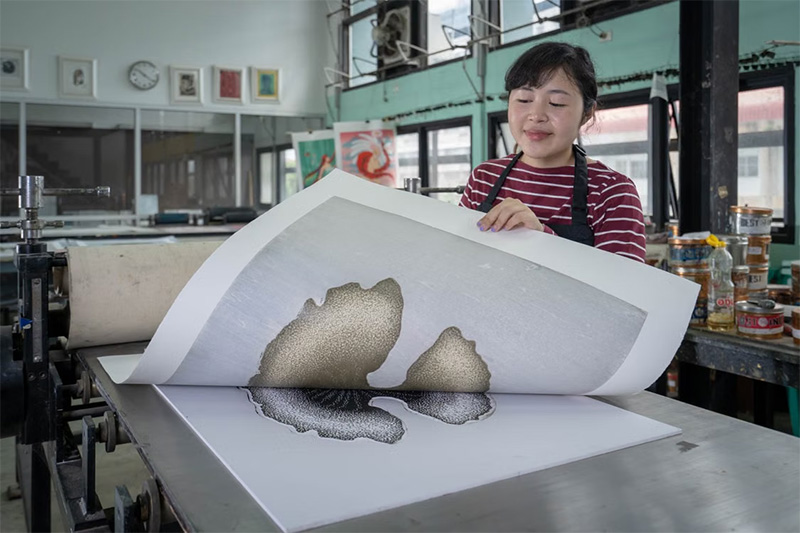
No single genius made most of these prints alone, and that fact wrecks the modern habit of worshiping the isolated artist. Ukiyo-e thrived through collaboration. A designer drew the image. A carver cut the blocks. A printer handled pigments, pressure, and paper. A publisher financed the project and chose what might sell. Commerce and craft locked arms. Full-color nishiki-e printing demanded exact alignment, and one small slip could ruin the image. The carver’s knife mattered as much as the designer’s line. The printer’s touch mattered too. This system resembled theater more than solitary painting. Many hands, one performance.
Masters and Shocks
A few names tower over the field, though each towers differently. Hishikawa Moronobu helped shape early directions. Suzuki Harunobu transformed color printing with delicacy. Kitagawa Utamaro gave women unusual presence and poise. Toshusai Sharaku produced actor portraits so sharp and strange that they still feel electric. Then come the giants who burst into global art history. Katsushika Hokusai turned line into force. Utagawa Hiroshige made rain, snow, and travel feel immediate. European artists later seized on these prints with hungry eyes. Flat color, cropped views, and daring compositions helped crack open Western habits of seeing.
Beauty and Ephemera
The strangest thing about ukiyo-e may be this. Much of it was cheap, popular, and never meant to carry the museum hush now wrapped around it. Prints advertised pleasures, celebrated stars, mapped travel, and circulated erotica with remarkable frankness. Those purposes were not side notes. They were the engine. Because the medium served mass audiences, it captured urban life with vivid force. Fashion, tourism, and celebrity obsession all sit there in plain sight. Modern culture likes to imagine itself as uniquely commercial and image-saturated. Nonsense. Edo already knew how to turn desire into reproducible pictures without losing beauty or formal daring.
Ukiyo-e survives because it did more than please the eye. It condensed a whole urban civilization into portable images that people could buy, hold, and remember. That union of artistry and mass circulation gives the form its lasting sting. One sees technical brilliance, certainly. One also sees celebrity culture, consumer hunger, tourism, erotic commerce, and the packaging of experience itself. The prints feel historical and current at once. Museums now frame them as treasures, which they are, though their first power came from movement through daily life. Every age flooded with images ends up standing in ukiyo-e’s shadow.
Photo Attribution:
1st & featured image by https://www.pexels.com/photo/woman-working-in-printing-workshop-9313700/
2nd image by https://www.pexels.com/photo/white-smoke-over-the-buildings-in-the-city-11330745/

