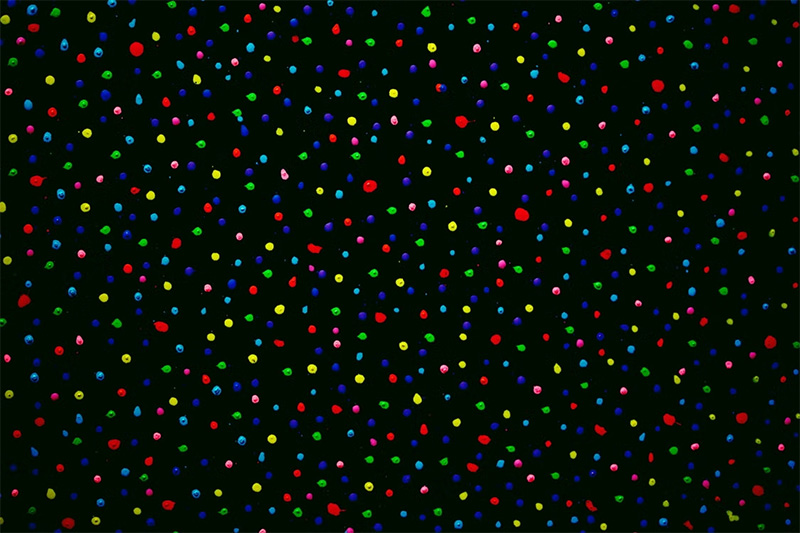
Yayoi Kusama built one of modern art’s clearest visual languages. A glance often does the trick. Dots spread across canvases, pumpkins, mirrored rooms, and environments. Plenty of artists develop a signature. Few turn it into a complete system. Kusama’s circles aren’t decoration or a branding trick for museum shops. They come from obsession, repetition, fear, control, and a fierce urge to dissolve the line between self and world. What appears playful can feel claustrophobic. What looks simple can carry private pressure. That tension gives the work its charge.
Dots as Fate
Kusama did not choose polka dots because they looked stylish on a wall. The dots arrived through lifelong visual and emotional experience tied to hallucinations and repetition. That origin changes everything. These marks don’t merely decorate surfaces. They overrun them. One dot becomes ten, then ten thousand, and suddenly objects lose stability. A chair no longer seems like just a chair. A body no longer seems sealed and firm. Here the art becomes more than pattern. It becomes a way to turn anxiety into structure. Repetition can soothe, and repetition can terrify. Kusama makes the dot both symptom and weapon.
Infinity With Teeth
The infinity rooms draw crowds because they offer spectacle. Mirrors, lights, reflections, color. Fine. Still, reducing those rooms to a photo opportunity misses the point. Kusama creates a collapse of scale inside them. A viewer stands in a small chamber and senses endless extension. That contradiction lands hard. Human beings crave the infinite in theory, then panic when it presses close. Kusama packages that confrontation in electric color and repetition. The result feels cosmic, but not in a soft, comforting way. It feels unstable. Reflection duplicates reflection until identity looks less like a fact and more like a temporary arrangement of light.
Pop, Pain, and Performance
Kusama often gets pushed into a neat box labeled whimsical pop visionary. That label isn’t entirely wrong. It’s also lazy. Her work touched Pop Art, performance, fashion, protest culture, and mass media, yet she never sat comfortably inside any single camp. That refusal gives the career its voltage. During the 1960s, she staged happenings, covered figures and objects with marks, and pushed art toward the body and the street. This wasn’t polished theory floating in a seminar room. It was confrontation. The dots could read as joy from one angle and psychic overflow from another. America likes neat categories. Kusama ruined them. Good.
The Pumpkin Problem
The pumpkins deserve more respect than they usually get. Too many viewers treat them as charming mascots, as if Kusama simply found a cute object and stamped it with circles. That reading shrinks the work. The pumpkin carries volume, awkwardness, humor, and plainness. It belongs to the earth. Kusama transforms this lumpy domestic thing into an icon without scrubbing away its oddness. Here the dots don’t erase form. They energize it. They make the surface pulse while the shape remains physical. Repetition does not always flatten the world. Sometimes it reveals character through pressure. A pumpkin can look comic and monumental at once.
Kusama’s staying power comes from more than recognizability. Plenty of recognizable art grows stale once fashion shifts. Her work survives because it stages a real conflict between delight and dread, surface and abyss, control and surrender. Museums love the crowds. Phones love the reflections. None of that cancels the deeper force of the work. The dots keep asking a rude question. How stable is the self that claims to observe them? Kusama never answers with a tidy slogan. She floods the space instead. She multiplies form until certainty thins out. That strategy feels urgent because modern life runs on repetition, overload, and fractured attention.
Photo Attribution:
1st & featured image by https://www.pexels.com/photo/dots-on-black-background-8879186/
2nd image by https://www.pexels.com/photo/vague-polka-dot-surface-5918616/

