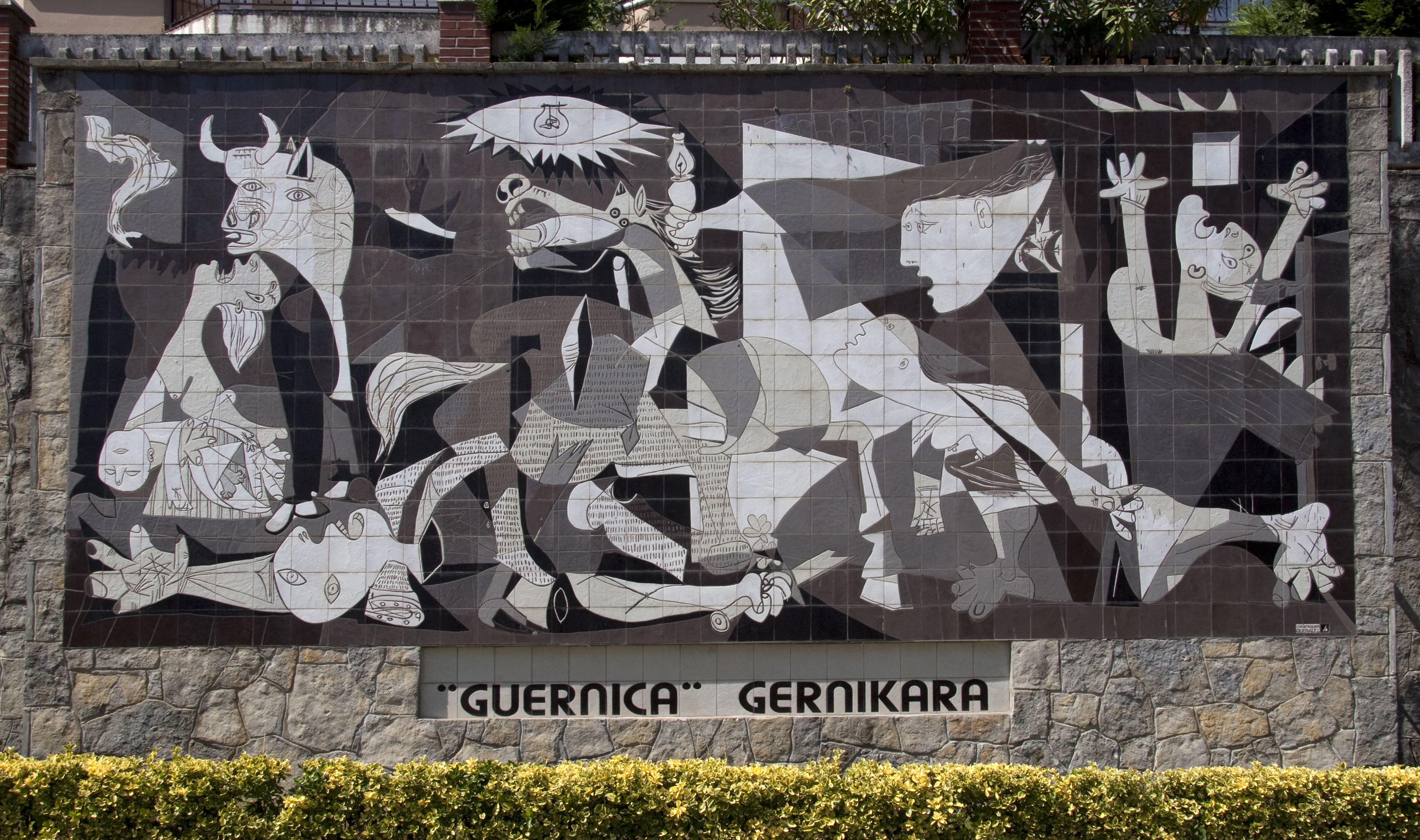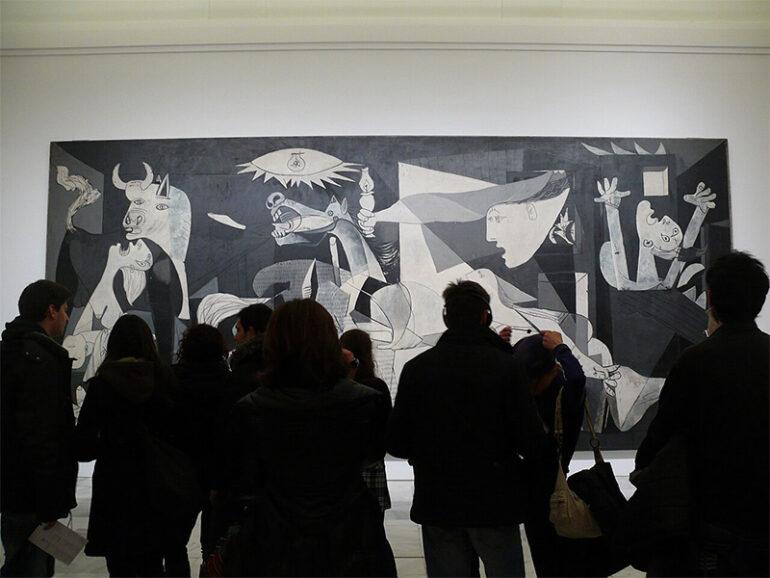
Few paintings have stirred up as much controversy, awe, and debate as that vast, chaotic canvas from 1937. It didn’t emerge out of thin air. Something dreadful pushed it into existence, a moment not just etched in Spanish memory but burned into the consciousness of the entire art world. The story isn’t about oil paint or fame; it’s about pain and protest, flung across a stretch of canvas with reckless honesty. For anyone searching for mere decoration or polite beauty, disappointment follows quickly. This artwork hurls itself at the viewer, unapologetic, overwhelming, absolutely unavoidable.
A City Torn Apart
April 26th, that date ought to leap out from every European history book: Guernica bombed, its residents thrown into terror by planes sent with one goal in mind. Not conquest or strategy, fear. The attack flattened homes, scattered families, left silence where life had bloomed just hours earlier. This wasn’t ancient warfare; this was twentieth-century brutality taken airborne. Headlines couldn’t quite capture it all: mothers running, animals screaming, the very earth shaking under explosives meant for civilians instead of soldiers. Shock waves spread far beyond Spain’s borders; even those who never heard a Basque song before understood what had been destroyed.
Picasso’s Dilemma
Pablo Picasso didn’t witness the bombing firsthand. Didn’t matter, he read about it in Paris and felt something snap internally. For years he’d experimented with abstract forms and new ways to see the world, but suddenly every brushstroke needed urgency. Commissioned to create a mural for Spain’s pavilion at the World’s Fair in Paris sounded like a routine job on paper; after seeing news reports and photographs of Guernica’s ruins, routine vanished completely. Instead came obsession: sketches flooding his studio day after day as Picasso searched for some visual language that matched the scale of outrage boiling inside him.
Symbols That Scream

No one walks away from that painting unmoved or unbothered by its crowded scene, horses throwing heads back mid-scream; women reaching desperately through broken walls; bulls watching silently amid chaos as if serving judgement over mankind’s madness. These symbols weren’t picked at random nor arranged gently, they’re confrontational on purpose. Black-and-white palette? Not an accident, it echoes grim newspaper photos that first brought home Guernica’s agony to Europe’s living rooms and cafes alike. Everything there squeezes meaning until it hurts, the bodies twisted not for effect but because truth is rarely tidy or comfortable.
The Artwork’s Legacy
Once unveiled at the Paris exposition in 1937, reactions split straight down ideological lines: supporters hailed it as genius protest; critics called it incomprehensible noise masquerading as art. But time gave an answer nobody could’ve predicted, “irrelevant” then became “iconic” later on museum walls worldwide. Protestors and peace movements adopted its shapes endlessly: banners echoing that angular horse head popping up decades later wherever violence needed confronting publicly again. Any notion that art can stay silent during horror died right here, in monochrome agony, and hasn’t revived since.
Some works exist to sooth nerves or flatter egos; this one exists only to unsettle and demand attention long after bombs have fallen quiet outside Guernica itself. Its message is simple enough, suffering should never be ignored or explained away by politics or power games, and yet artists still study those jagged forms hunting clues on how protest can live eternally on canvas rather than fade under dust covers somewhere forgotten by history’s winners.
Photo Attribution:
1st & featured image by https://commons.wikimedia.org/wiki/Category:Guernica_(Pablo_Picasso)#/media/File:Pablo_Picasso’s_Guernica.jpg
2nd image by https://upload.wikimedia.org/wikipedia/commons/a/ad/Guernica_%283820712635%29.jpg


#/media/File:Pablo_Picasso's_Guernica.jpg)