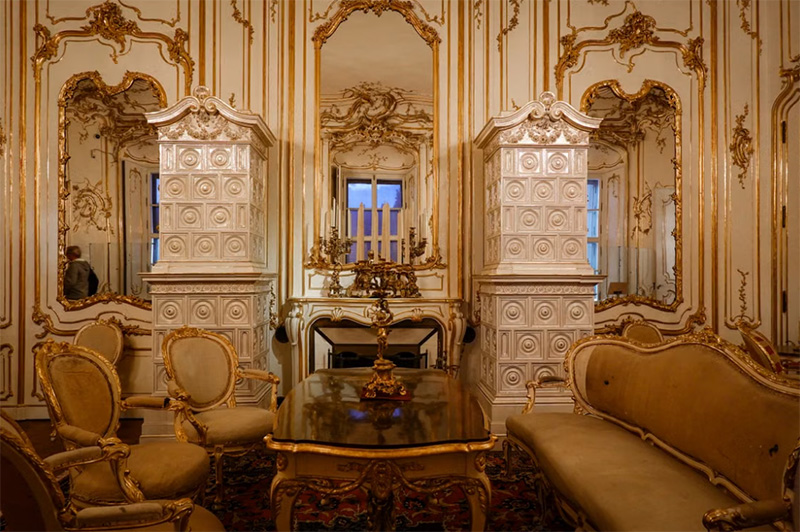
Rococo refuses to sit still. That fact explains much of its charm. The style rose in eighteenth century France after the grandeur of Louis XIV had worn itself out. That shift matters. Baroque had thundered. Rococo laughed. Where the earlier mode loved weight and ceremony, the newer one chased pleasure, flirtation, and movement. Walls curled. Mirrors multiplied. Shells, vines, cupids, and clouds drifted across rooms as if gravity had grown bored. This wasn’t carelessness. It was discipline disguised as ease. What makes the style playful is not mere decoration. It’s the feeling that the world softened and agreed to dance.
Curves in Motion
Straight lines rarely dominate Rococo because straight lines behave too much like rules. Rococo distrusted rules that announced themselves. A chair leg bends. A wall panel twists. A carved frame squirms around a painting instead of standing at attention. That restless curve creates visual wit. The eye never lands and salutes. It wanders. It skips. It gets lured onward by asymmetry and ornament that seems to grow like ivy rather than snap into place like masonry. Playfulness begins when form stops lecturing and starts teasing. Rococo interiors encourage gossip, flirtation, and quick glances. The room becomes social before speech.

Pleasure as Subject
Rococo painting often turns toward gardens, fêtes, mythological flirtation, music, silk, and staged intimacy. Critics who call this shallow miss the point. Art doesn’t become trivial because it studies delight. Delight can expose a culture with brutal clarity. Watteau, Boucher, and Fragonard filled scenes with moments suspended between innocence and seduction, theater and confession. That uncertainty gives the work its sparkle. A playful style needs stakes, even if the stakes look featherlight. A stolen glance can carry more voltage than a battle scene when the artist knows timing. Rococo knows timing. It knows how to pause before the joke lands. Elegance becomes lively with mischief.
Rooms That Perform
Rococo lives especially well in interiors because the style treats a room as an event, not a container. Paneling, furniture, porcelain, clocks, sconces, and ceiling painting join the same performance. This unity creates a strange effect. Nothing sits alone. Every object seems to answer another object across the room. A gilt curve on the mirror echoes a curl on the console table. A painted cloud above repeats the softness of upholstery below. Here it becomes buoyant because variation keeps interrupting order. A salon stages conversation. Society prized wit, speed, and polished manners, and the décor learned those habits.
Lightness with Teeth
The common mistake is to treat Rococo as fluffy sugar. That reading collapses under a closer look. The style loves pastel color, polished surfaces, and ornamental abundance, yet beneath the sweetness lies something sharper. Play often carries a tiny blade. Rococo art can feel artificial on purpose, and that self-aware artifice gives it bite. It knows courtly life is a game. Behind the coquettish scenes lurk status anxiety and the fragility of pleasure in a world built on hierarchy. Frivolity alone bores. Frivolity with nerve fascinates. Rococo smiles while revealing that elegance can become strategic performance.
Playfulness in Rococo comes from a rare mix of freedom and control. The curves seem spontaneous, yet craftsmen planned them with obsessive care. The subjects seem light, yet they pulse with social tension and erotic wit. The rooms seem airy, yet they guide movement, sight, and conversation with precision. This is why the style still feels alive. It doesn’t simply decorate surfaces. It changes behavior. People stand differently in a Rococo room. They speak differently. They notice how charm can function as power and how beauty can wink instead of preach. Rococo aims for seduction, and seduction remains one of art’s serious games.
Photo Attribution:
1st & featured image by https://www.pexels.com/photo/luxurious-baroque-style-palace-interior-design-29982281/
2nd image by https://www.pexels.com/photo/abstract-flowing-lines-in-blue-and-brown-hues-33706957/

