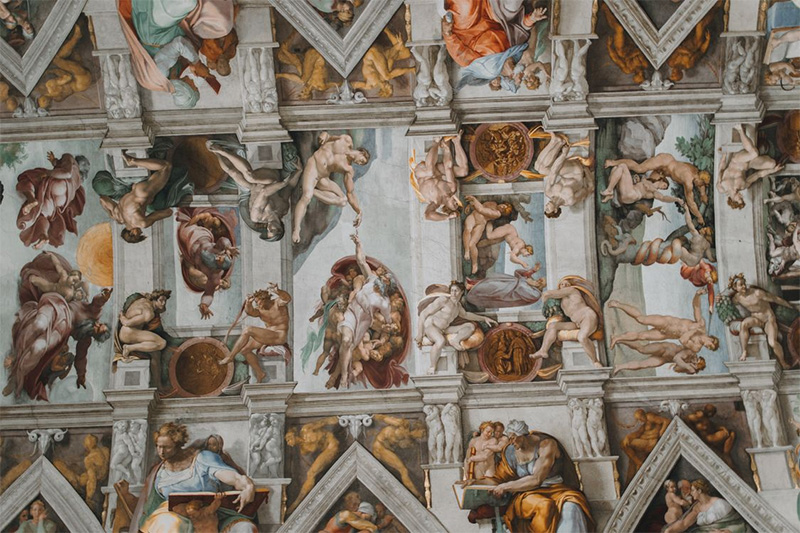
The ceiling of the Sistine Chapel sits in that rare category of human work that refuses to behave. It doesn’t politely “represent” the Renaissance. It bullies the Renaissance into definition. Michelangelo, a sculptor with the temperament of a storm front, took a commission that began as routine papal decoration and turned it into an argument about bodies, power, and imagination under pressure. The painted surface stretches overhead like an invented sky, yet it never plays backdrop. It stares back. That insistence explains why tourists crane their necks and why scholars keep circling the same frescoes like moths around a dangerously bright lamp.
A Commission That Smelled Like Politics
Julius II didn’t hire Michelangelo out of gentle admiration. Julius wanted spectacle, dominance, a Vatican that looked inevitable. Patronage in Rome worked like that. Money arrived with strings, and those strings yanked hard. Michelangelo arrived with his own agenda and a famous refusal to act tame. The original plan called for apostles, a respectable lineup, the kind of imagery that satisfies committees. Michelangelo expanded it into a program that swallows Genesis, prophecy, ancestry, and the uneasy boundary between flesh and spirit. The painter didn’t just follow orders. The painter negotiated with power in pigment.
The Body as Theology, Not Decoration
The ceiling’s figures don’t float like polite saints on a gilded panel. They weigh something. They twist, brace, slump, lunge, brood. Michelangelo treated anatomy as a serious language, not a garnish. Adam’s reach toward the Creator reads as biology colliding with metaphysics, the spark of life rendered as a near-touch that feels almost rude in its intimacy. Prophets and sibyls sit like exhausted titans, as if revelation hurts the spine. Theology here doesn’t hide inside symbols. It marches around in muscle and tendon, as if the human body itself argues for meaning. Beauty distracts, and beauty functions as a trap.
Scaffolds, Sweat, and the Myth of the Easy Genius
Popular stories love the lone genius, serenely inventing masterpieces between sips of wine. That story collapses in the chapel. Michelangelo worked high above the floor on scaffolding, managing plaster, timing, assistants, supplies, and the fact that fresco punishes hesitation. Paint too slowly and the plaster dries. Paint carelessly and the surface keeps the mistake like a grudge. Physical discomfort joined the daily routine. Neck craned, arms raised, eyes irritated. The result looks effortless only because the labor succeeded. People call it genius as if genius means magic. Genius here means control under conditions that wanted failure.
Restoration, Color, and the Fight Over What’s “Real”
The late twentieth-century restoration reopened an old argument with fresh heat. Clean the ceiling and the colors leap out. Bright blues, pinks that look modern. Keep the grime and the ceiling stays solemn, “ancient” in the way audiences expect. Some critics accused the restoration team of erasing subtle shading, of scrubbing away intended mood. Supporters answered with chemistry and documentation, pointing to soot, glue, and centuries of candle residue. One stubborn fact remains. The ceiling has never stayed fixed. It has lived through smoke, dust, politics, and human taste. Complaints about authenticity reveal nostalgia for a preferred past.
Michelangelo’s ceiling keeps winning attention because it refuses to settle into a single meaning. It serves the Church and questions the human condition in the same breath. It celebrates creation and shows strain everywhere, as if existence arrives with pain built in. The scale overwhelms, yet the intelligence sits in smaller decisions: a hand that hesitates, a gaze that turns inward, a body that looks both heroic and tired. Critics can argue about symbolism, restoration choices, or the artist’s temperament. The painted vault keeps standing there, indifferent to the debate, gathering new interpretations year after year. That durability doesn’t come from prettiness. It comes from force, and force ages well.
Photo Attribution:
1st & featured image by https://www.pexels.com/photo/ceiling-of-the-sistine-chapel-in-vatican-city-29319293/
2nd image by https://www.pexels.com/photo/hofburg-palace-statue-in-vienna-austria-29689541/

